Crypto trading signal provider tools can feel like trying to drink from a firehose. Every day, you see new “guaranteed profits” claims, screenshots of impossible win rates, and Telegram groups promising life-changing returns. The truth is simpler and more useful: the best crypto trading signal provider tools don’t magically predict the market, but they can help you make faster, more disciplined decisions with clear entry zones, stop-loss levels, take-profit targets, and risk controls.
When signals are paired with solid risk management, realistic expectations, and a system that fits your trading style, they can reduce hesitation and improve consistency. In this guide, you’ll learn how crypto trading signal provider tools work, which features matter most, how to verify track records, and how to build a practical setup for spot and crypto futures signals without falling for hype.
What Are Crypto Trading Signal Provider Tools and How Do They Work?
At their core, crypto trading signal provider tools are platforms, bots, dashboards, or communities that deliver actionable trade ideas. A “signal” is usually a structured suggestion such as an asset to trade, a direction to take, and a plan for where to enter and exit. Quality providers often include a rationale based on technical analysis, order flow, volatility, or market structure.
Most modern crypto trading signal provider tools deliver alerts through apps, browser notifications, email, or messaging platforms. Many traders prefer Telegram crypto signals because they’re instant and easy to follow, but speed alone doesn’t equal quality. The real value comes from clarity and consistency: you want signals that define invalidation levels, specify position sizing guidelines, and adapt to changing market conditions.
Some providers also integrate with exchanges through APIs. This can enable automated entries, partial take profits, trailing stops, and analytics. Automation can be helpful, but it raises the stakes: if the logic is flawed or the settings are wrong, the tool will execute mistakes at lightning speed.
Signal Types You’ll See in the Real World
In practice, crypto trading signal provider tools tend to fall into a few signal styles. One style focuses on swing trades, holding positions for days or weeks. Another focuses on scalps that aim for quick moves. You’ll also see dedicated crypto futures signals designed for leverage, which require stricter stop-loss discipline because small price moves can create large account swings.
You may also encounter “portfolio signals” that act more like allocation guidance rather than trade-by-trade calls. Those can be useful for long-term investors, but they’re not the same as an entry/exit signal.
Where Signals Come From
Signals usually come from one of three sources. The first is human analysts using technical analysis patterns, indicators, and experience. The second is algorithmic systems that scan charts and generate alerts when conditions match a rule set. The third is hybrid approaches that combine scanning tools with human confirmation.
The strongest crypto trading signal provider tools are transparent about which approach they use, what timeframes they trade, and what conditions invalidate a setup. When a provider can’t explain their method at all, that’s a red flag.
Why Traders Use Crypto Trading Signal Provider Tools in 2026
Crypto markets move fast, and the emotional pressure can be intense. Traders use crypto trading signal provider tools to reduce decision fatigue and avoid impulsive trades. A well-structured signal can replace guesswork with a plan, which matters far more than “predicting” the future.
Another reason traders adopt crypto trading signal provider tools is efficiency. Instead of monitoring charts all day, you can filter opportunities and focus only on higher-probability setups. That’s especially helpful if you trade part-time or across multiple coins.
Finally, many traders use signals as education. When a provider explains why they entered, where the invalidation sits, and what the risk-to-reward looks like, you learn faster. Over time, you can compare outcomes and refine your own strategy.
Signals vs Copy Trading vs Trading Bots
It’s easy to mix up crypto trading signals, copy trading, and bots. Signals deliver trade ideas; you still execute manually. Copy trading automatically mirrors another trader’s positions. Trading bots execute pre-defined rules. Each has pros and cons, but signals are often the most flexible because you keep control. If you’re learning, signals can be safer than blindly copying because you can skip trades that don’t fit your risk limits.
Crypto Trading Signal Provider Tools Features That Actually Matter
A lot of platforms advertise flashy dashboards, but a serious trader cares about a few practical features.
Reliable delivery is essential. If alerts arrive late, the entry price is gone and the trade plan breaks. Next is signal structure. Good crypto trading signal provider tools specify entry ranges, invalidation points, and multiple take-profit levels, not vague “buy now” messages.
Performance reporting matters too. A trustworthy provider shows full trade history with timestamps, not cherry-picked winners. You want to see how they handle losing streaks, whether they respect stops, and how performance changes in different market regimes.
Risk controls are another key feature. The best crypto trading signal provider tools encourage position sizing, max daily loss limits, and leverage guidelines. If a provider constantly pushes high leverage without talking about risk, that’s not a strategy, it’s a gamble.
Exchange Compatibility and Integrations
If you trade on Binance, Bybit, OKX, Kraken, Coinbase, or other major exchanges, you’ll want tools that match your venue. Some platforms offer integrations that convert alerts into trade tickets or automation rules. That can be useful, but only if you understand slippage, fees, and how the tool handles partial fills.
Because many people search for “Binance signals” and “best crypto signals,” you’ll see providers claiming perfect compatibility. Instead of trusting marketing, confirm whether the tool supports your exact market type: spot, margin, or perpetual futures.
Transparency and Verification
If a provider claims a high win rate, verification becomes non-negotiable. Screenshots can be faked. Look for verifiable logs, public performance trackers, or consistent timestamped posts that can be cross-checked. Strong crypto trading signal provider tools also explain assumptions, such as the expected entry method and whether they assume limit orders or market orders.
How to Choose the Best Crypto Trading Signal Provider Tools for Your Style
Choosing crypto trading signal provider tools is less about “best overall” and more about fit. A scalper needs rapid updates and tight risk control. A swing trader needs fewer, higher-conviction setups and wider stops. A futures trader needs strict guidance on leverage and liquidation risk. Start by matching timeframe. If your job prevents you from watching charts, high-frequency Telegram crypto signals may be a bad fit, even if the provider is skilled. You’ll miss entries and get frustrated.
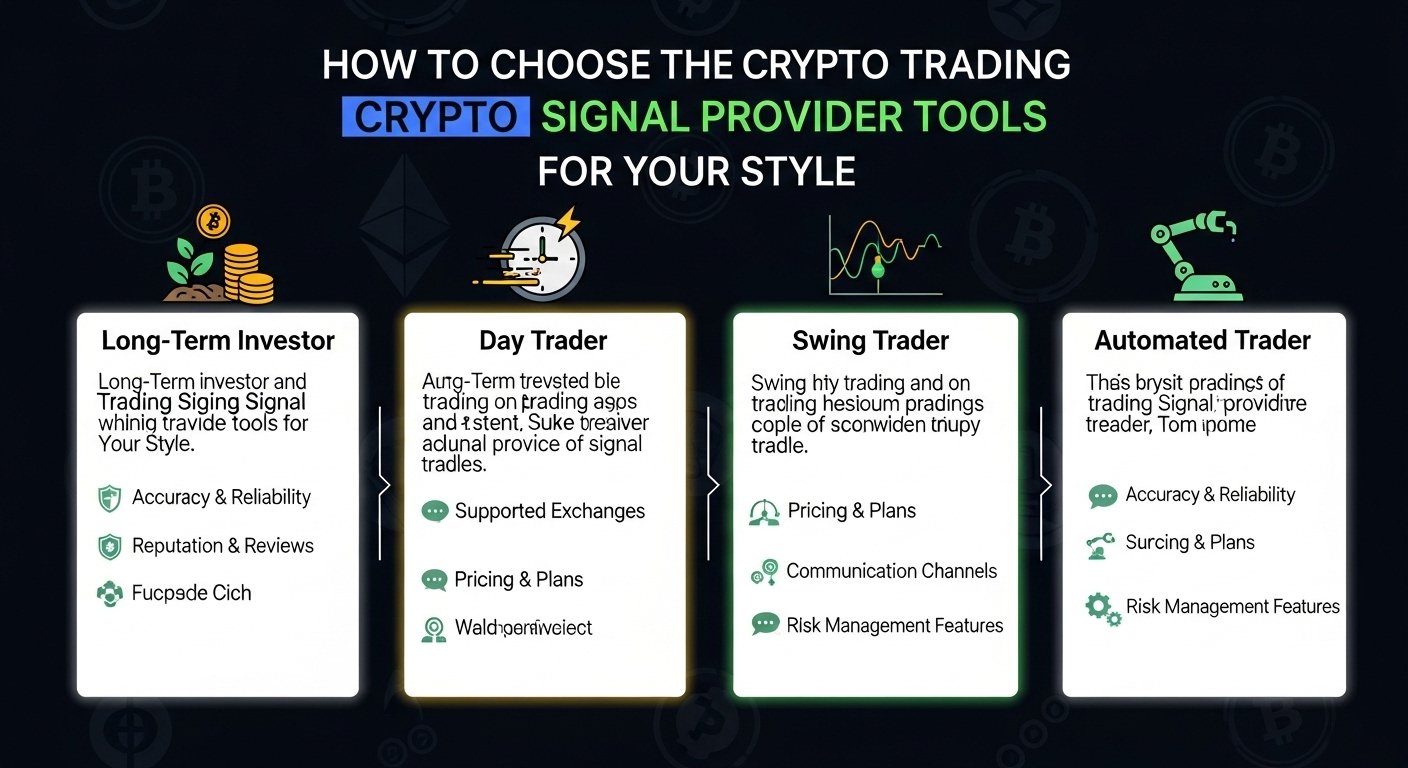
Next, match volatility tolerance. Some providers trade small-cap coins that move wildly. Others stick to BTC and ETH. If you can’t emotionally handle big swings, choose tools that focus on more liquid markets and emphasize risk management. Also consider your execution preference. If you want manual control, choose tools that send clear alerts. If you want automation, choose platforms with robust API controls, safety features, and conservative defaults.
Questions to Ask Before You Pay
Before subscribing, ask how the provider measures performance, what fees are refundable, and whether they include risk guidance. Ask how they handle major news volatility and whether they pause signals during chaotic conditions. A real professional will answer clearly, because strong crypto trading signal provider tools don’t rely on mystery.
Performance Metrics You Should Track with Crypto Trading Signal Provider Tools
To judge any signal service, you need metrics that reflect reality. Win rate alone is not enough. A provider can win often but lose big when wrong. Pay attention to average win versus average loss, which is basically the risk-to-reward profile. Consistency matters too: are returns stable or dependent on a few lucky trades?
Drawdown is crucial. Many traders ignore it until it wipes them out. A tool that experiences deep drawdowns may be too aggressive for most users, even if it looks profitable on paper. Also look at trade frequency and fee impact. If a provider sends many signals, fees and slippage can quietly erase gains. This is especially important for crypto futures signals, where funding rates and spreads can matter.
Realistic Expectations
Even excellent crypto trading signal provider tools have losing streaks. If a service claims they “never lose,” that’s a warning sign, not a selling point. A healthier expectation is a system that aims for long-term edge, protects capital, and survives bad months.
Avoiding Scams and Overhyped Crypto Trading Signal Provider Tools
Because “crypto trading signals” is a high-demand niche, scams are common. Some groups manipulate low-liquidity coins, telling members to buy while insiders sell. Others show fake profits, then upsell “VIP” tiers.
One major red flag is pressure tactics. If a provider pushes you to “join now before the next pump,” they’re selling urgency, not quality. Another red flag is vague signals. If the messages don’t include clear invalidation levels or risk guidance, the provider can always claim you “executed wrong.”
Be careful with providers who constantly change identities or delete old messages. Strong crypto trading signal provider tools maintain a consistent record, even when trades go wrong. Losses are part of trading; hiding them is dishonest.
The Psychology Trap
Some traders hop between signal services after every loss. That creates a cycle where you never stick long enough to evaluate properly. If you choose crypto trading signal provider tools, commit to tracking results with consistent rules for at least a meaningful sample of trades, while keeping risk small.
Building a Practical Setup Using Crypto Trading Signal Provider Tools
A good setup combines signals with structure. You need a process for receiving alerts, evaluating them, executing, and reviewing results. Start with a clean execution flow. When an alert arrives, your first step is checking market context. Is the asset trending? Is volatility unusually high? Are you near a major event? Then you decide whether the signal matches your plan.
Next comes position sizing. Even perfect entries fail sometimes, so your risk per trade must be controlled. The best crypto trading signal provider tools make sizing guidance easy, but you can also use a simple risk rule: decide how much of your account you’re willing to lose if the stop hits, then size accordingly. Finally, review weekly. Track which types of signals work best for you, which markets you execute well, and which conditions lead to mistakes. Over time, your results will improve not only because of the tool, but because your discipline improves.
Spot Trading vs Crypto Futures Signals
Spot trading is simpler because you’re not dealing with liquidation and leverage. Many beginners do better in spot first. Crypto futures signals can be powerful, but they demand strict stop-loss execution and conservative leverage. If you’re new, choose crypto trading signal provider tools that teach risk first and hype last.
Pairing Signals with Technical Analysis
Signals work best when you understand the why. If a provider references market structure, support/resistance, RSI, moving averages, or volume, learn what those mean. Over time, you’ll filter bad trades and confidently execute good ones. That’s how crypto trading signal provider tools become an accelerator instead of a crutch.
Conclusion
The right crypto trading signal provider tools won’t replace your judgment, but they can dramatically improve your speed, structure, and consistency when you use them with discipline. Focus on clarity, verified performance, and strong risk management rather than hype. Choose tools that match your timeframe, support your exchange, and teach you how decisions are made through technical analysis and repeatable rules. If you’re ready to upgrade your trading workflow, start testing crypto trading signal provider tools today with small risk, track every trade, and build a system you can trust over the long run.